Driving to Miami International: expressways, tolls and parking
6 min read
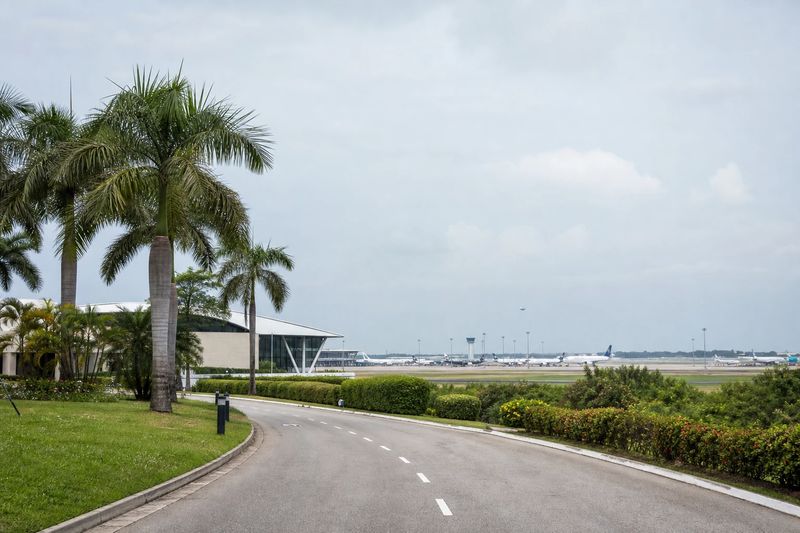
Miami International Airport (MIA) sits about 8 miles by road from downtown Miami, FL — roughly 17 min of driving, or 6.2 miles in a straight line.
Miami International sits west of downtown, close in, and surrounded by some of the busiest road in Florida. The airport itself is straightforward once you understand its shape. Getting to it is the part that varies.
Getting there by road
Two toll expressways carry most airport traffic. SR 112, the Airport Expressway, comes in from I-95 and the north side of the city. SR 836, the Dolphin Expressway, comes in from downtown and carries on west toward the Turnpike and the suburbs beyond it. Between them they cover most approaches from the east and the west.
On surface streets, LeJeune Road runs along the eastern edge of the airport and NW 36th Street along the northern edge. Both are useful if you are coming from Miami Springs, Hialeah or Doral, and both are also the fallback when something has gone wrong on an expressway. Further west, SR 826 — the Palmetto — is the north-south route that connects the whole thing together.
The variable is the time of day. The stretch of the Dolphin closest to downtown is a long-standing bottleneck, and both expressways carry heavy commuter loads in the morning and from mid-afternoon onward. Because the distance from the center is small, congestion has an outsized effect on the total: the same journey can comfortably take twice as long depending on when you leave.
Tolls
South Florida expressway tolls are collected electronically. Nothing stops at a booth; the charge is read from a transponder or from the plate and billed later. That is efficient if the car is yours and expensive if it is not, because rental companies typically add an administration fee for each toll they process. Ask at the counter how it works before you drive off — it is a two-minute conversation that occasionally saves a genuinely annoying amount of money.
One terminal, arranged by letter
MIA does not have separate terminal buildings you drive between. It has one long building curved around the aprons, divided into North, Central and South sections, with concourses identified by letter.
That has two consequences for a driver. First, you are not choosing a terminal, you are choosing where along a very long frontage to stop — so it is the concourse letter you need before you commit to a lane. Second, if you get it wrong, the fix is a lap of the airport roadway rather than a short walk.
The departures and arrivals roadways are stacked, with departures above. Because the frontage is so long, it takes both pieces of information — the level and the concourse letter — to know where you actually want to stop, and a driver who has only one of the two will be going round again. If you are being dropped off, settle both before you leave rather than over the phone in moving traffic.
Inside, the same geometry means the walks can be long. Moving walkways help on the longer stretches, and the longest concourse has its own internal train. If you are connecting rather than starting your trip here, look at where your gates actually are instead of assuming adjacent letters mean adjacent gates.
The Intermodal Center and the MIA Mover
Just east of the airport is the Miami Intermodal Center, a purpose-built transport hub that holds the rental car facilities and the rail platforms. The terminal connects to it by the MIA Mover, an automated train.
For drivers this matters most on the way home. Rental returns happen at the Intermodal Center, not at the terminal, so the last stage of your drive is followed by a train ride with your luggage. It is short. It is not zero, and building it into your timings is the difference between a calm arrival and a rushed one.
Parking, close in or further out
There is garage parking along the terminal frontage and cheaper long-stay parking away from the building. The logic is the same as everywhere: the closer you are, the more you pay and the less you carry your bags.
For a short trip, terminal-adjacent parking is easy to justify. For a week or more, the outer options are the sensible choice. The one piece of homework worth doing in advance is which garage serves your concourse, because the frontage is long and the signage assumes you already know where you are heading.
Taking the train instead
Metrorail reaches the Intermodal Center, and the MIA Mover completes the trip to the terminal. Commuter and intercity rail use the same hub. For anyone staying in downtown Miami without a car, that combination is straightforward and it ignores the expressways entirely, which on a bad afternoon is worth a great deal.
Driving in from further out
MIA draws from the whole southern end of the state. Fort Lauderdale and West Palm Beach both send traffic down I-95 or the Turnpike, though both have their own airports and the choice is usually decided by which flight you want rather than which drive is shorter. Naples and the southwest coast come across on I-75 through the Everglades — fast, empty and with almost nowhere to stop.
The Keys are the interesting case. US 1 is the only road, so there is no alternative route if something closes it, and the drive up the island chain deserves a much larger margin than the distance implies. Anyone flying out of Miami after a week in the Keys should plan to be boringly early.
For the alternatives further up the coast and elsewhere in the country, the other airport guides cover the same ground for each one.
Driving to MIA from nearby cities
Estimated road distances and drive times to the terminal area. Add your own margin for parking, the shuttle and check-in — these figures cover the drive only.
| From | Distance | Drive time |
|---|---|---|
| Miami, FL (downtown) | 8 mi | 17 min |
| Flagami, FL | 4 mi | 7 min |
| Fountainebleau, FL | 5 mi | 10 min |
| Allapattah, FL | 6 mi | 12 min |
| Doral, FL | 6 mi | 12 min |
| Hialeah, FL | 6 mi | 12 min |
| Coral Gables, FL | 7 mi | 14 min |
| Tamiami, FL | 10 mi | 19 min |
| Kendall, FL | 11 mi | 22 min |
Every figure here is an estimated road distance, worked out the same way as the rest of the site — how the estimate works. Distances in kilometers: downtown Miami, FL is about 14 km away.