Winter driving on a long trip: what changes about snow, ice and timing
8 min read
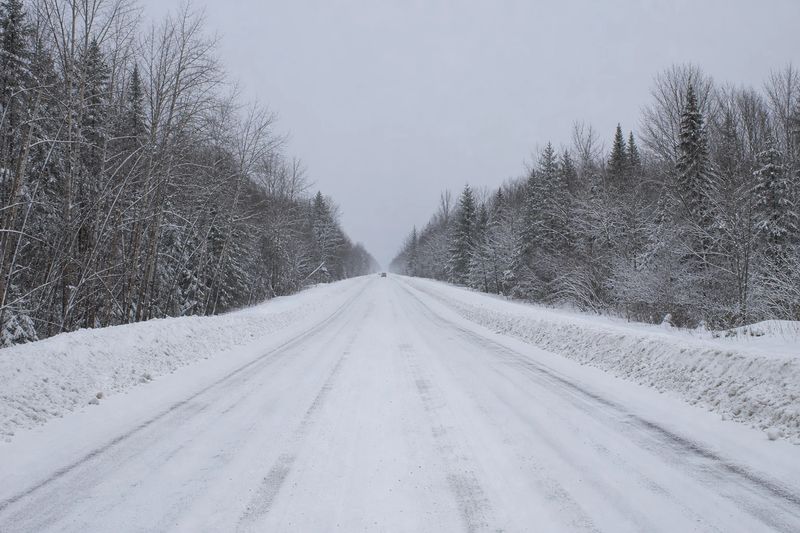
Winter does not make a long drive uniformly harder. It makes four specific things harder — grip, visibility, daylight and the reliability of your own schedule — and each of those has a specific answer. The distance stays exactly the same. Almost nothing else does.
What winter changes about the plan
Any drive time estimate assumes ordinary conditions: dry road, no delays, traffic where you would expect traffic. Winter breaks that assumption in a way that is hard to plan around, because the delay is not spread evenly. A route can run at normal speed for three hundred miles and then take two hours to cover the next thirty, because that thirty is where the weather is.
The practical consequence is that you cannot fix a winter trip by adding a fixed margin. What works instead is planning a shorter day and building in the option to stop early.
- Set a target mileage well below what you would attempt in summer, and treat the arrival time as the first thing you are prepared to lose.
- Decide before you leave where you would stop if the day goes wrong — not just the destination, but the two or three towns before it where you could break the journey.
- Check the weather along the whole route rather than at both ends. A storm sitting over the middle of the drive matters more than clear skies at either end, and elevation changes the picture: the same system that is rain in the valley is snow at the summit.
- Look at road conditions, not just forecasts. Most states run a road conditions service — 511 by phone, and a website showing closures, restrictions and plow status — and it is the closest thing to a live picture of the route you will get.
None of this works without knowing where the places on the route actually are and how far apart they sit. That is the difference between “stop early if it gets bad” as an intention and as a plan you can act on.
Daylight is the constraint people forget
In the middle of winter the usable driving window is short, and it is short at both ends. A day that would be comfortable in June becomes a day that finishes in the dark.
That matters for two reasons that reinforce each other. Visibility is worse, so hazards appear later and you have less information about the surface. And roads that were treated and running wet during the afternoon tend to refreeze as the temperature drops after sunset, so grip can deteriorate at the exact moment you can see least. The hour after dark is often the worst hour of a winter day to be driving.
The fix is arithmetic. Work backward from sunset rather than forward from breakfast: decide what time you want to be off the road, subtract the drive time, and that is your departure. If the answer is uncomfortably early, the trip is two days. Putting the dark hours at the start of a day after a proper night’s sleep is a different proposition from tacking them onto the end, which is covered in more detail in the guide to managing fatigue on long drives.
Grip is the whole game
Everything that goes wrong in winter goes wrong through the tires.
Tires and pressures
Tread depth is what clears water and snow out from under the contact patch. Worn tread does not lose grip gradually in the wet and on snow — it stops working. Check depth across the full width of each tire before a long winter trip, not just in the middle.
Dedicated winter tires do two things ordinary tires do not: the rubber compound stays pliable at low temperatures instead of hardening, and the tread pattern is cut to bite into snow. If the route involves repeated snow and ice, they are the single biggest improvement available. Good all-season tires handle cold and occasional slush and give up progressively as conditions worsen.
Cold air contracts, so tire pressures fall as the temperature does. Check them cold, before driving, against the figure on the door pillar rather than the number molded into the sidewall.
Some mountain routes require chains or other traction devices at certain times. When they do, the requirement is posted and enforced, so the thing to establish before you leave is whether your vehicle can take them and whether you know how to fit them without an audience of stopped traffic behind you.
The surfaces that fool you
Packed snow is slippery and looks slippery, which makes it easier to handle than ice that does not. Black ice is a thin transparent layer that shows the color of the asphalt underneath, so it reads as a wet patch. It forms where the surface is coldest: bridges and overpasses chilled from both sides, shaded curves, dips where cold air pools, sections near water, and anywhere meltwater has run across the road and refrozen. Assume it in the first hours after sunrise and after sunset.
Driving on a surface with reduced grip is mostly about making inputs smaller and earlier. Look much further ahead than usual, so that steering, braking and speed changes can all be gradual. Leave a following distance that feels absurd, because stopping distances on snow are a multiple of what they are on dry road. If the car starts to slide, lifting off does more than braking.
Four-wheel drive is worth having and worth being suspicious of. It helps you accelerate and pull away. It does nothing for stopping and nothing for cornering grip, which are the two situations that actually hurt. The failure mode is a capable vehicle traveling faster than the surface allows, driven by someone who will find out about it while trying to slow down.
Mountain passes
If the route crosses a pass, the pass decides whether the trip works.
Conditions at the summit have little to do with conditions in the valleys on either side. The temperature is lower, the weather arrives sooner, and a road that is merely wet at the bottom can be snow-covered a few thousand feet up. Check the pass status on the day you travel.
A few things follow from that:
- Fuel before the climb, not after. Services are further apart in the mountains, and a closure can leave you idling in a line for a long time.
- Descend in a lower gear and let the engine do the braking. Riding the brakes down a long grade heats them until they fade, which is a problem that announces itself at the worst moment.
- Know your alternative route and price it honestly. Around a closed pass, the detour is often hundreds of miles rather than tens, and it is much easier to accept that at the planning stage than at a barrier in the dark.
The vehicle and what rides in it
Cold does not usually break things. It exposes whatever was already marginal.
Before a long winter trip, work through the parts that the cold tests: the battery, which is where most winter no-starts come from; the coolant mixture, which needs to suit the temperatures on the route rather than the ones at home; the wiper blades, which do more work in a winter week than a summer month; and the washer fluid, which needs to be rated for freezing temperatures and which you will get through far faster than you expect clearing salt spray. Keep the lights and their lenses clean, because road grime coats them within an hour of setting off. Run the fuel tank higher than usual.
Clear the whole vehicle before moving, not just a porthole in the windshield. Snow left on the roof arrives on the glass under braking, and snow over the lights makes you invisible from behind.
Then there is what you carry, which is really a question of how long you would be comfortable if you stopped moving:
- Warm layers, and a blanket that lives in the car rather than one you meant to bring.
- Water, and food that stays edible when cold.
- A charged power bank, and a charging cable that works in the car.
- An ice scraper and a brush. A small shovel if there will be snow.
- Something to put under a spinning wheel — sand, grit or cat litter.
- A flashlight, a way to jump-start the battery, and a basic first aid kit.
- Any medication you take, in the car rather than in checked luggage.
- The route written down, because phones die in the cold faster than they do anywhere else.
If you do get stuck, staying with the vehicle is almost always right. It is shelter and it is findable. Keep the exhaust clear of snow before running the engine, run it in short intervals to stretch the fuel, and make sure someone knows the route and when you expected to arrive — that is the step that turns being stuck into being looked for.
Deciding not to go
The most useful winter driving skill is being willing to wait. A system passing through costs a few hours of sitting still; the same system driven into costs the hardest hours of driving you will do that year, and may still end with you stopped somewhere unplanned.
That decision is much easier if the trip was built to allow it, which mostly means not scheduling anything immovable on the arrival day.
Working out the real distance and drive time is where the staged plan starts. Put the two places into the calculator on the home page and you get the mileage, the drive time and the towns along the route — which is what you need to decide how far is reasonable before dark, and where you would stop if it is not.