Driving to Boston Logan Airport: the harbor tunnels and parking
6 min read
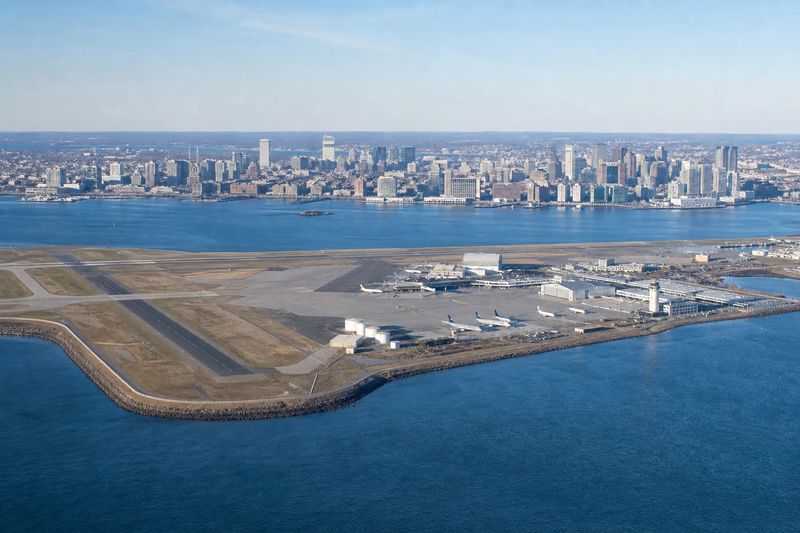
Logan International Airport (BOS) sits about 4 miles by road from downtown Boston, MA — roughly 7 min of driving, or 2.7 miles in a straight line.
Logan is one of the closest major airports to the downtown it serves. It is also one of the more awkward to drive to, and both facts have the same cause: the airport is on the far side of the harbor, and everything reaching it goes through a tunnel or around the water.
Getting there by road
The airport occupies filled land in East Boston, directly across the inner harbor from downtown. There is no long approach freeway and no dedicated spur through open country. Instead there are three main ways in.
From the south and west, the Ted Williams Tunnel carries I-90 under the harbor and puts you close to the terminals. That is the natural route off the Massachusetts Turnpike and the one signed for the airport from most of the region.
From downtown Boston and the North End, the Callahan Tunnel is the outbound crossing to East Boston. Its counterpart, the Sumner Tunnel, brings traffic back the other way into the city. They work as a pair and it is worth knowing which direction each one runs before you set off.
From the north shore, Route 1A runs down the coast and past the airport, which is the standard approach from Revere, Lynn and points beyond.
The tunnels are tolled and collection is electronic. Nothing stops, and the charge is read from a transponder or from the plate. In a rental car, ask how tolls are handled before you drive away — the per-toll fee rental companies add is frequently larger than the toll.
The tunnels are also the whole story of the timing. On a clear run the drive from the city center is a few minutes. In a queue it is a different journey entirely, and there is very little scope to route around a blocked crossing because the alternatives are few and they all lead to the same water.
The terminals
Terminals are lettered A, B, C and E, set around a one-way loop road. There is nothing lettered D, so the gap in the sequence is normal. Terminal E is the international building.
Confirm your terminal before you reach the airport. The signs on the approach are organized by terminal letter and the loop is one-way, so a wrong turn costs a full circuit past every other terminal. Curbside is split between departures and arrivals by level at the larger terminals, which is the other easy mistake to make while reading signs at speed.
Shuttle buses circulate the loop and are the usual way to move between terminals on the public side, with some walking and post-security connections depending on the pair involved. None of that is quick, so if you are meeting an arriving passenger it is better to agree one location than to reposition the car.
Curbside and pick-ups
Departures and arrivals sit on separate levels at the larger terminals, and because the loop is tight there is not much room to hesitate once you are on it. There is a designated waiting area for drivers meeting an arriving passenger, and given how little spare ground the airport has, using it rather than circling is more than a courtesy. Agree the terminal and the level before anyone sets off.
Parking
There is a large central garage inside the terminal loop, additional garage capacity at individual terminals, and cheaper long-stay parking further out with a shuttle.
Logan has a constraint most large airports do not: it is physically hemmed in. There is no room for endless surface lots, so the close-in capacity is finite and it can genuinely fill during busy periods. That makes parking here worth thinking about in advance rather than assuming a space will exist. For a longer trip the outer parking is both cheaper and less of a gamble.
Leaving the car at home
For anyone staying in central Boston, the case for not driving is strong. The Blue Line reaches an Airport station with a shuttle bus to the terminals. The Silver Line runs from South Station to the terminals directly. There is also passenger boat service across the harbor, which is the rare airport transfer people actively enjoy.
The common thread is that none of them use a tunnel by car. On a weekday afternoon that is worth more than any time saving on paper. If you are visiting rather than departing, the same logic applies in reverse — a car is more of a liability than an asset in central Boston.
Driving in from further out
Logan is the principal long-haul airport for New England, and its catchment reflects that. Providence and Worcester are short drives. Hartford and Springfield come across on I-84 and I-90. Portland and southern Maine come down I-95. Cape Cod comes up Route 3 and over the bridges, which in summer is a longer trip than the mileage suggests.
Northern New England adds a wrinkle in winter. A storm that has already cleared Boston may still be sitting over New Hampshire or Vermont, which means the drive can be the worse half of the journey even when the flight itself is running on time.
Plenty of people drive past a closer airport to use Logan, because the range of destinations justifies it. When you are weighing that, compare door to door: the drive plus parking plus the terminal, against a shorter drive and a connection. The distance table below gives you the first half, and the other airport guides cover the alternatives.
Driving to BOS from nearby cities
Estimated road distances and drive times to the terminal area. Add your own margin for parking, the shuttle and check-in — these figures cover the drive only.
| From | Distance | Drive time |
|---|---|---|
| Boston, MA (downtown) | 4 mi | 7 min |
| Revere, MA | 4 mi | 9 min |
| Everett, MA | 5 mi | 11 min |
| Somerville, MA | 7 mi | 14 min |
| Cambridge, MA | 7 mi | 14 min |
| Malden, MA | 7 mi | 14 min |
| Brookline, MA | 8 mi | 17 min |
| Medford, MA | 9 mi | 17 min |
| Quincy, MA | 10 mi | 21 min |
Every figure here is an estimated road distance, worked out the same way as the rest of the site — how the estimate works. Distances in kilometers: downtown Boston, MA is about 6 km away.