Driving to Denver International Airport: Peña Boulevard and parking
6 min read
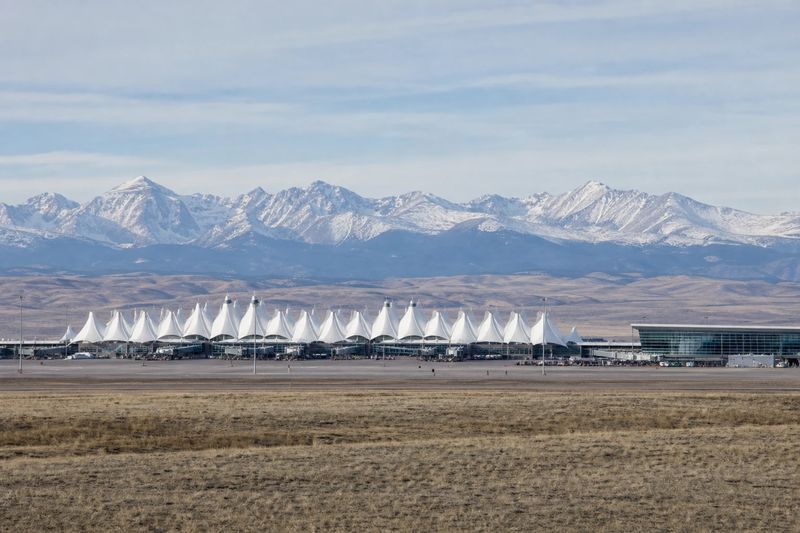
Denver International Airport (DEN) sits about 23 miles by road from downtown Denver, CO — roughly 36 min of driving, or 18.6 miles in a straight line.
Denver International is a long way from Denver. Not awkwardly placed, just genuinely distant: it was built out on the plains with room around it, and the drive reflects that. The airport itself is one of the simpler large ones to arrive at by car. The distance is the part that catches people out.
Getting there by road
There is one road in. Peña Boulevard leaves the interstate on the northeast side of the metro and runs out across open ground to the terminal, and there is no meaningful alternative route. When it is clear, the drive is easy — a wide, fast, uninteresting highway with almost nothing beside it. When it is not, you wait.
The outer toll route around the eastern side of the metro connects to it, which is useful if you are coming from the north or the south and would rather not cross the city. It is electronically tolled, so there is nothing to stop for — the charge is read from a transponder or from the license plate and billed afterward. Rental drivers should check how their company passes those charges on, since the fee added per transaction is often larger than the toll. From downtown, the run is out on the interstate and then onto the boulevard for the final stretch.
That final stretch is deceptive. It is long, straight and empty, the terminal roof is visible from a considerable distance, and drivers consistently underestimate how much of the journey is left. Near the terminal the road divides for departures, arrivals and parking, and it backs up at the peaks.
One terminal, three concourses
This is the good news. There is a single terminal building — the Jeppesen Terminal, under the white peaked roof that everyone recognizes — and all check-in and baggage claim happens there. There is no terminal to choose on the approach, and no way to arrive at the wrong building.
The gates are in three lettered concourses beyond the terminal. An underground automated train runs out to them and back continuously, and the nearest concourse can also be reached on foot across a bridge. Everything else is a train ride.
Because the airport is physically large, the inside portion of the journey is not a rounding error. If you land at a far gate and have parked in an outer lot, the distance from seat to car involves a train, a walk and a bus. Allow for it.
Parking
The choice runs from garages beside the terminal, through close-in surface lots, to economy and shuttle parking well out from the building. Prices follow the walking distance, as usual.
What is different here is scale. On a site this open, remote parking is properly remote, and the shuttle ride is several minutes rather than one. For a short trip the garages earn their premium. For a week away, the outer lots make sense and the bus is simply part of the plan.
Rental cars are collected and returned away from the terminal, with shuttle buses covering the gap. As at any airport with that arrangement, returning a car is three stages rather than one: the drive to the facility, the return, then the bus. Because the site is so large, those stages are longer here than at a compact airport, and it is the most common reason people arrive at the terminal later than they planned.
The drop-off and pickup levels sit on the roadway in front of the terminal, and they get congested at the peaks in the way that any single-frontage airport does. If you are collecting someone, waiting somewhere off the terminal roadway until they actually have their bags is more comfortable than circling.
Taking the train instead
A commuter rail line links Denver Union Station to a station at the south end of the terminal. You arrive at the building, under cover, without touching Peña Boulevard. It is not affected by traffic, which is the whole point, and several suburban stations along the way have their own parking if you would rather drive part of the distance and ride the rest.
For anyone staying downtown without a car, it is usually the better answer. For families with luggage coming from the suburbs, driving still wins.
Winter, and the drive from further out
The airport sits where the weather is worse than in the city. Blowing snow across open prairie cuts visibility quickly, and conditions at the terminal can be significantly worse than they were when you left home. Peña Boulevard and the interstates east of the city have both been closed in serious storms. When snow is in the forecast, the sensible plan is an earlier start than the mileage suggests.
The Front Range corridor feeds this airport along its whole length. Colorado Springs, Boulder, Fort Collins, Greeley, Pueblo and Cheyenne are all comfortable one-way drives, and travelers from western Kansas and Nebraska use it too. Coming from the north or the south, the eastern toll route often beats going through the middle of Denver.
One thing worth planning for if you are heading to the mountains: the high country is west of the city and the airport is northeast of it, so the resort drive begins with a metro crossing. The distance table below covers the road portion, and the distance calculator will handle the onward legs. The other airport guides follow the same pattern if you are comparing options.
Driving to DEN from nearby cities
Estimated road distances and drive times to the terminal area. Add your own margin for parking, the shuttle and check-in — these figures cover the drive only.
| From | Distance | Drive time |
|---|---|---|
| Denver, CO (downtown) | 23 mi | 36 min |
| Aurora, CO | 17 mi | 27 min |
| Thornton, CO | 19 mi | 31 min |
| Commerce City, CO | 19 mi | 31 min |
| Westminster, CO | 24 mi | 37 min |
| Broomfield, CO | 27 mi | 43 min |
| Centennial, CO | 27 mi | 43 min |
| Arvada, CO | 27 mi | 43 min |
| Parker, CO | 29 mi | 47 min |
Every figure here is an estimated road distance, worked out the same way as the rest of the site — how the estimate works. Distances in kilometers: downtown Denver, CO is about 36 km away.