Driving to O'Hare International: access roads and parking
6 min read
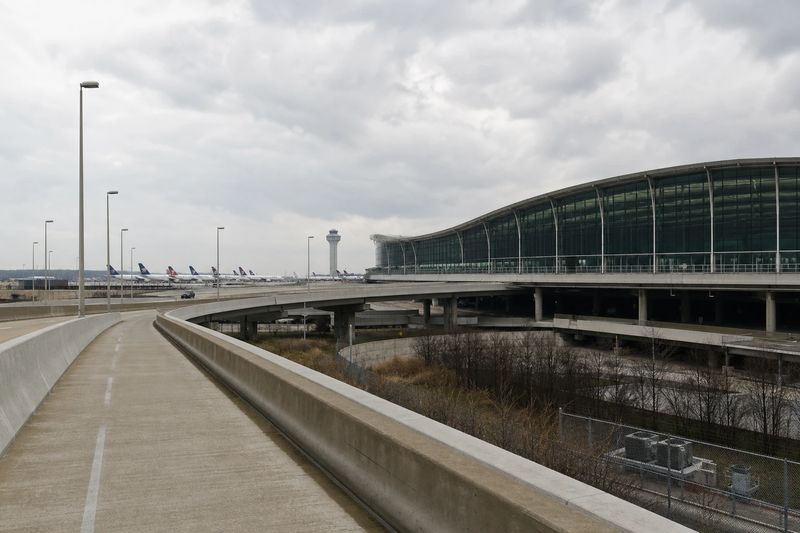
O'Hare International Airport (ORD) sits about 19 miles by road from downtown Chicago, IL — roughly 30 min of driving, or 15.8 miles in a straight line.
O’Hare is one of the busiest airports in the world, and it behaves like it. The flying part is somebody else’s problem; the driving part is worth planning, because the airport is large enough that the last two miles can take as long as the previous twenty.
Getting there by road
Access is via a dedicated spur that leaves the Kennedy Expressway and runs directly into the terminal area. That spur is the only road route into the core of the airport, which is convenient when traffic is light and a bottleneck when it is not.
Two practical points:
- Departure signage is organized by terminal number, not by airline. Know your terminal before you are committed to a lane. The terminal loop is one-way, and correcting a mistake means going around again.
- The Kennedy is the variable. The distance from downtown is modest, but the time it takes is entirely dependent on when you travel. The morning outbound and the afternoon inbound peaks both bite, and resurfacing work is a regular feature of the warmer months.
Terminals and moving between them
Passenger terminals are numbered 1, 2, 3 and 5. They are connected to each other, and to the remote parking and rental-car facilities, by the airport’s automated Airport Transit System, which runs continuously.
If you are parking in an outer lot, the transit ride is part of your journey time rather than an afterthought. It is reliable, but it is not instant, and it is the step most people forget when they work backwards from their departure time.
Parking
The choice is the familiar one between cost and walking distance. Garage parking sits close to the terminals and is priced for short stays; the long-stay lots are further out and connected by the transit system.
For anything longer than a couple of days the outer lots generally make sense. For a quick drop-off, the terminal-adjacent options save enough time to be worth it. Either way, decide before you arrive: the signage assumes you already know where you are going.
Driving in from further out
O’Hare draws from a wide area, and plenty of people drive past a closer airport to use it. Southern Wisconsin, northwest Indiana and much of northern Illinois are all within a sensible one-way drive, which is why the long-stay lots exist at the scale they do.
If you are weighing the drive against flying from somewhere nearer, the honest comparison is door to door: the drive to O’Hare plus parking plus the airport itself, against the shorter drive to a smaller airport plus a possible connection. The distance table below gives you the first half of that calculation.
Driving to ORD from nearby cities
Estimated road distances and drive times to the terminal area. Add your own margin for parking, the shuttle and check-in — these figures cover the drive only.
| From | Distance | Drive time |
|---|---|---|
| Chicago, IL (downtown) | 19 mi | 30 min |
| Des Plaines, IL | 5 mi | 11 min |
| Elmhurst, IL | 8 mi | 16 min |
| Mount Prospect, IL | 9 mi | 17 min |
| Arlington Heights, IL | 12 mi | 23 min |
| Lombard, IL | 12 mi | 23 min |
| Glenview, IL | 12 mi | 24 min |
| Oak Park, IL | 12 mi | 24 min |
| Skokie, IL | 13 mi | 26 min |
Every figure here is an estimated road distance, worked out the same way as the rest of the site — how the estimate works. Distances in kilometers: downtown Chicago, IL is about 31 km away.