Driving in Chicago, IL: parking, tolls and what to stop for
8 min read
Chicago is one of the easier big American cities to drive in and one of the more awkward ones to drive into. The street grid is close to perfectly regular, numbered outward from the corner of State and Madison, so once you are inside the city you can usually work out roughly where you are without looking anything up. Getting to that point, though, means running the gauntlet of the expressways, and then solving the real problem: what to do with the car once you have arrived.
This guide covers the practical side — the roads in, how the tolling works, where to leave a vehicle — and then the parts of the city that justify the effort.
The roads into Chicago
Chicago sits at the point where a large share of the country’s road freight changes direction, and the expressway network reflects that. Three routes carry most traffic into the center: the Kennedy from the northwest and O’Hare, the Eisenhower from the western suburbs, and the Dan Ryan from the south. All three converge on the Loop, and all three slow to a crawl at the same times of day.
A few things are worth knowing before you commit to a route:
- The expressways have local names, and the signs use them. Interstate numbers appear too, but radio traffic reports and conversation use Kennedy, Eisenhower, Dan Ryan and Stevenson. Learning the four names is a small investment that pays off quickly.
- Express and local lanes split on parts of the Kennedy. The express lanes skip several exits and occasionally reverse direction with the commute. If your exit is close, stay local.
- Construction season is real. Winters are hard on the road surface, so a great deal of resurfacing is compressed into the warmer months. Lane closures are common and not always signed far ahead.
Tolls and the ring roads
The orbital routes around the metropolitan area are tolled, and the tolling is fully electronic. There are no booths to stop at on the main lanes: traffic passes under a gantry at normal speed and the charge is read from a transponder in the windscreen, or billed against the license plate if there is no transponder fitted.
For a visitor this matters mostly in a rental car. Rental companies handle electronic tolls in their own ways, and the per-toll administrative fee they add is frequently larger than the toll itself. Ask at the counter how it works and whether a transponder is already fitted, before you drive off and find out the expensive way.
Where to leave the car
This is the decision that shapes a Chicago visit more than any other.
Street parking in and around the Loop is metered, well enforced, and scarce enough that looking for it costs more time than it saves. Garages are plentiful but priced accordingly, and the difference between a garage a few blocks from where you want to be and one directly underneath it can be substantial.
The strategy that works for most visitors is to park once. Chicago’s center is compact and flat, the lakefront path runs for miles, and the elevated train covers the gaps. Moving the car between the Loop, the Museum Campus and the North Side means paying to park three times and sitting in traffic in between.
If you are staying outside the city — and many people driving in from elsewhere are — the better move is often to leave the car where you are sleeping and take the train in. Several suburban lines run frequently enough to make this painless, and the fare for two people is usually less than a few hours of downtown parking.
What is worth stopping for
Chicago rewards walking, so this list is organized by where you can leave a vehicle once and see several things on foot.
The Loop and Millennium Park
The center of the city is its own attraction: an unusually dense collection of significant buildings, from the early skyscrapers that were largely invented here to the recent towers along the river. Millennium Park anchors the northern edge, with the mirrored Cloud Gate sculpture that everyone photographs and a bandshell that programs free concerts through the summer.
The Art Institute of Chicago sits immediately south of the park and is one of the strongest collections in the country. If you have one indoor afternoon in the city, that is where to spend it.
The lakefront and Museum Campus
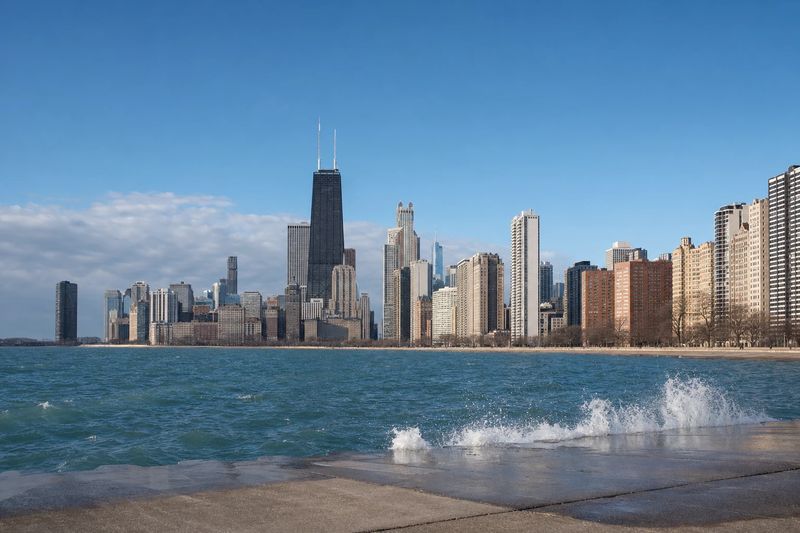
South of the Loop, three major museums cluster on the lakefront within a short walk of one another, which makes them the best single-parking stop in the city. The lakefront path runs past them in both directions — north towards Navy Pier and the beaches, south along the water — and the view back towards the skyline from anywhere along it is the picture most people have in their heads when they think of Chicago.
The river
The Chicago River runs through the middle of downtown and is lined by buildings designed to be seen from it. The architecture boat tours that leave from the riverside docks are, unusually for something so heavily promoted, genuinely worth doing: the city reads completely differently from water level, and the commentary is substantive rather than decorative.
Beyond the center
North of downtown, the neighborhoods along the lake are pleasant to walk and easy to reach by train — including Wrigley Field, which sits in the middle of an ordinary residential street grid rather than in a parking lot, and is worth seeing even on a day with no game. Further out, the city becomes a collection of distinct neighborhoods, each with its own main street, and this is where a car starts to earn its keep again.
Using Chicago as a base
Chicago’s position makes it a good starting point rather than only a destination. Milwaukee is a short run north. The Indiana Dunes are close enough for a half day. Michigan’s lakeshore towns are a straightforward drive around the bottom of the lake, and Indianapolis, Detroit and St Louis are all reachable and back within a long weekend.
The table below lists what is within four hours’ driving, with estimated distances and times, so you can see what a day trip actually costs before you plan one.
Within four hours' drive of Chicago
Places you can reach in a single sitting, with estimated road distance and drive time. Pick any row for the full route, including the towns you would pass.
| Destination | Distance | Drive time |
|---|---|---|
| Bolingbrook, IL | 29 mi | 46 min |
| Joliet, IL | 39 mi | 1 hr 1 min |
| Elgin, IL | 43 mi | 51 min |
| Kenosha, WI | 60 mi | 1 hr 12 min |
| Racine, WI | 71 mi | 1 hr 25 min |
| Waukesha, WI | 99 mi | 1 hr 59 min |
| Janesville, WI | 105 mi | 2 hr 6 min |
| Bloomington, IL | 136 mi | 2 hr 16 min |
| Kokomo, IN | 143 mi | 2 hr 23 min |
| Madison, WI | 143 mi | 2 hr 23 min |