Driving to Dallas/Fort Worth Airport: access roads, tolls and parking
6 min read
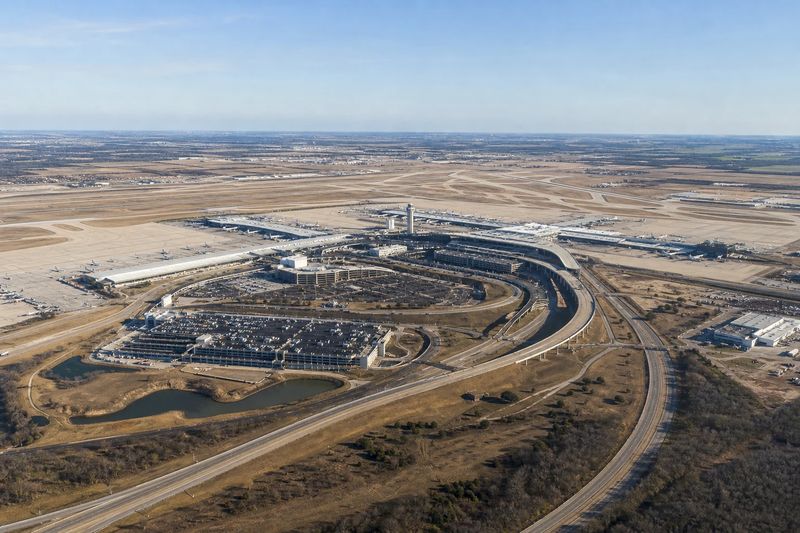
Dallas/Fort Worth International Airport (DFW) sits about 19 miles by road from downtown Dallas, TX — roughly 30 min of driving, or 15.6 miles in a straight line.
DFW does not sit next to a city. It sits between two of them, on a piece of land large enough that the airport is bigger than several American downtowns, and the drive is organized around that fact. Everything on the ground here is longer than you expect and better signed than you expect.
Getting there by road
The airport is fed from the north and the south, and the two ends are connected by a central roadway that runs the length of the site. Highways approach from the north near Grapevine and from the south near Euless and Irving, and either way you end up on that spine, working your way along it until you reach your terminal.
There is a toll to use it. Plazas at the entrances charge for access to the airport’s own roads, which catches out first-time visitors who assume the drop-off is free. If you park, it is folded into the parking charge. If you are in a rental, find out before you set off how the company handles tolls — the fee they add per transaction is frequently larger than the toll.
The distance from either downtown is moderate and the time depends on which side you start from. Approaching from the Dallas or Fort Worth side is usually fine outside the peaks. Crossing the whole metro to get here is a different proposition, and the mid-cities corridor between the two downtowns is heavy for much of the day.
Terminals and how they are arranged
There are five, lettered A, B, C, D and E. Each is a semicircle, and they are spaced out along the central roadway rather than clustered together. Terminal D handles most of the international traffic.
The practical consequence of the layout is that the terminals are miles apart on the ground. Signage on the approach is by letter, and it is unambiguous, but it assumes you know which letter you want. Check your airline’s terminal before you leave, not while you are choosing a lane.
Moving between terminals
Inside security, Skylink is the automated train that links all five terminals in both directions. It is the reason a connection here is manageable despite the distances — you can travel the short way around rather than the long way, and it runs continuously.
Landside, shuttle buses circulate between the terminals, the remote parking and the rental car facilities. They work, but they are slower, and they are subject to the same airport roads as everyone else. If you have a connection and your bags are checked, stay inside.
Parking
Every terminal has a garage directly across from it. This is genuinely unusual: at most large airports, terminal parking still means a hike, and here it does not. For short trips it is the obvious choice.
Cheaper express and remote parking sits away from the terminals with shuttle bus connections. For longer stays the savings add up, and the shuttle ride becomes part of your journey time rather than an afterthought. Decide which you want before you arrive, because the parking signage follows the terminal signage and both come at you quickly.
Rental cars are handled at a consolidated facility away from the terminals, reached by shuttle bus. Returning a car therefore has three stages — the drive to the center, the return itself, then the bus to your terminal — and on a site this large none of them is instant. This is the step that most often turns a comfortable margin into a rushed one, so treat it as a real part of the schedule rather than a formality at the end.
Taking the train instead
Rail reaches DFW from both sides of the metro. DART serves Terminal A from Dallas, and TEXRail serves Terminal B from Fort Worth. In both cases the station is at the terminal, not at a shuttle stop on the edge of the airport.
Neither line is quick against an unobstructed drive. Both are immune to traffic, which before a flight is often worth more than raw speed. And if you are traveling without a car at the other end, the train removes the parking question entirely. The driving in Dallas guide covers the wider metro road network if you are weighing this against a rental.
Driving in from further out
DFW draws from most of North Texas and well beyond it. Oklahoma City, Waco, Tyler, Wichita Falls and Shreveport are all comfortable one-way drives, and Austin and Houston are done often enough that the long-stay lots are sized for it.
If you are choosing between driving here for a nonstop and flying from a closer airport with a connection, compare door to door: this drive, plus the toll, plus parking and the walk, against the shorter drive and the extra flight. The table below gives you the driving half, and the distance calculator will do the rest of the route arithmetic.
One weather note for the longer approaches. North Texas does not get much snow, but it does get ice, and freezing rain closes bridges and overpasses across the region faster than most visitors expect. When that happens the interstates into the metro become genuinely dangerous rather than merely slow, and flight schedules tend to unravel at the same time. If ice is forecast, the right response is to move the drive earlier rather than to leave on schedule and hope.
Driving to DFW from nearby cities
Estimated road distances and drive times to the terminal area. Add your own margin for parking, the shuttle and check-in — these figures cover the drive only.
| From | Distance | Drive time |
|---|---|---|
| Dallas, TX (downtown) | 19 mi | 30 min |
| Grapevine, TX | 5 mi | 9 min |
| Coppell, TX | 6 mi | 11 min |
| Euless, TX | 7 mi | 13 min |
| Bedford, TX | 10 mi | 19 min |
| Irving, TX | 11 mi | 21 min |
| Flower Mound, TX | 12 mi | 24 min |
| Carrollton, TX | 13 mi | 26 min |
| Lewisville, TX | 14 mi | 29 min |
Every figure here is an estimated road distance, worked out the same way as the rest of the site — how the estimate works. Distances in kilometers: downtown Dallas, TX is about 31 km away.